
A professional color consultant does more than choose attractive paint colors. They help clients select palettes that work with lighting, architecture, and existing materials. Becoming one takes color knowledge, practical judgment, and the ability to explain recommendations clearly.
This guide walks you through professional color consultant training, hands-on experience, portfolio building, specialization, and finding clients, with advice from a working expert.
To help you get started, we spoke with Max Ruthven, founder of Let’s Talk Color and a QC Design School graduate. Since graduating from QC’s Interior Decorating & Design program in 2014, Max has continued building her skills through color-focused courses and hands-on projects. Today, she specializes in architectural color consulting for residential and commercial properties and shares her expertise through professional presentations and educational resources.
What Does a Professional Color Consultant Do?
A beautiful paint color isn’t always the right color for a space.
It needs to work with the lighting, existing materials, architecture, and everything around it. That’s where a professional color consultant comes in.
As QC Design School graduate Max Ruthven explains:
“If you’re building a house, renovating a kitchen or replacing an expensive roof, you’re making color decisions long before you’re choosing pillows, artwork or a side table. Those permanent decisions need to relate to one another.”
— Max Ruthven, Founder, Let’s Talk Color & QC Design School Graduate
A professional color consultant considers those relationships, creates a cohesive palette, and helps clients understand why each recommendation works for their space.
Through her business, Let’s Talk Color, Max specializes in architectural color consulting, where even the placement of a color on a particular surface can make a difference. As Max puts it: “A color can be beautiful and still be wrong for the conditions in which it has to live.”

Photos courtesy of Max Ruthven / Let’s Talk Color.
What Happens During a Professional Color Consultation?
What does a color consultant actually do when a client hires them?
Every project is different, but a professional color consultation typically involves five key stages:
- Understand the client’s goals. Discuss the space, the client’s preferences, and what they want to achieve.
- Assess the existing conditions. Look at lighting, architecture, flooring, countertops, and other materials that influence color choices.
- Develop a color palette. Recommend colors that complement the space and work together.
- Present recommendations. Explain the reasoning behind each selection and help the client make confident decisions.
- Provide a color plan. Depending on the service, this might include paint specifications, finish recommendations, or guidance on where each color belongs.
For Max, the process starts long before choosing paint samples.
“I don’t begin with the paint deck. I begin with the conditions the color has to live in.”
— Max Ruthven, Founder, Let’s Talk Color & QC Design School Graduate
For example, an exterior consultant may need to choose a white that complements an existing tiled roof, then specify where it belongs across the stucco, trim, garage doors, and architectural details. A cohesive result depends on placement as much as the paint color.
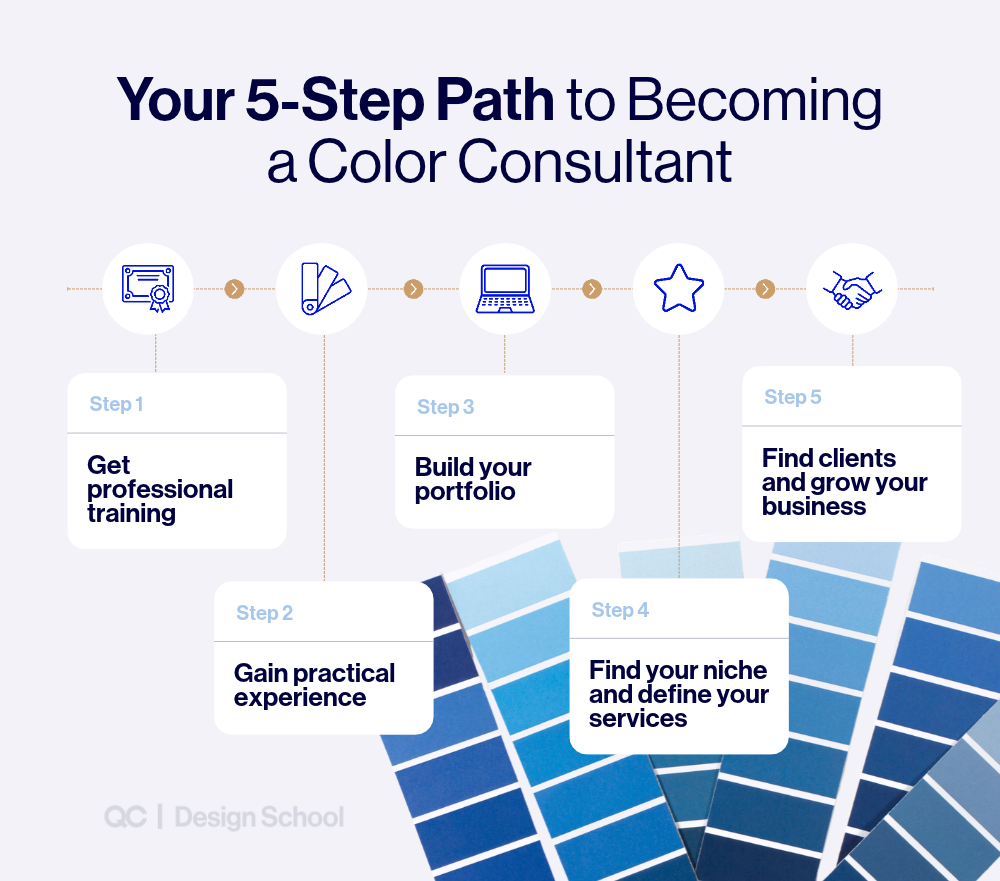
How to Become a Professional Color Consultant in 5 Steps
To become a professional color consultant, learn color theory, lighting, and how colors interact with materials. Then gain practical experience, build a portfolio, choose the services you want to offer, and find clients. Professional training can help you build the skills and confidence to make informed recommendations. There’s no single career path: some consultants start with dedicated color training, while others build on experience in decorating or home staging.
Here are five steps to help you build your skills and turn your interest in color into a career, with advice from QC graduate Max Ruthven.
Step 1: Get Professional Color Consultant Training
Having a natural eye for color is a great starting point. But to advise clients professionally, you need to understand why colors work together.
When we asked Max where aspiring color consultants should begin, her advice was simple:
“I would start with Color 101 and resist the temptation to skip it.”
— Max Ruthven, Founder, Let’s Talk Color & QC Design School Graduate
She recommends beginning with color theory, including hue, value, chroma, and color relationships. From there, explore how lighting, architecture, and existing materials influence color decisions.
These fundamentals help you make recommendations you can explain with confidence. A paint color can look different depending on the direction of natural light, surrounding materials, and artificial lighting. As her career evolved, Max continued learning about color science, lighting, and architectural color. Advanced concepts include light reflectance value (LRV), which describes how much visible light a surface reflects, and metamerism, when colors appear to match under one light source but not another.
What Should You Look for in a Color Consulting Course?
Look for a program that combines color theory with practical application and business preparation. Key areas include:
- Color theory and perception: Understanding color relationships, lighting, and how we see color.
- Practical applications: Creating palettes for interiors, exteriors, and existing finishes.
- Client consultations: Understanding client needs and presenting recommendations.
- Business skills: Pricing, marketing, and building a client base.
Turn Your Eye for Color Into a Career
Earn your ICCP™ certification online
Learn color theory, practical consulting skills, and how to build your business with QC Design School’s online Color Consultant Course. Get hands-on practice, expert tutor feedback, and earn your ICCP™ certification.
Explore the Course
Photos courtesy of Max Ruthven / Let’s Talk Color.
Step 2: Gain Practical Color Consulting Experience
You don’t need paying clients to start putting your color consulting skills into practice.
Start with a room in your own home, or help friends and family explore new palettes. Observe the color in morning and afternoon light, alongside the flooring, cabinets, and other finishes. As the National Institute of Standards and Technology explains, lighting influences how we perceive color.
Max recommends starting small, testing your recommendations in real conditions, and learning from the outcome. Notice which choices work and what you would change next time.
And as you practice, don’t just focus on choosing beautiful colors. Learn to explain why your recommendations work. That ability to communicate your decisions is just as important as developing your eye for color.
Every project gives you an opportunity to improve your skills and prepare for working with clients.
Step 3: Build Your Color Consulting Portfolio
You can start building your portfolio with practice projects, student assignments, or work for friends and family. Show the before and after, but also explain the original challenge, the materials you worked with, and why you recommended each color.
For example, Max’s exterior work for Let’s Talk Color shows how a thoughtfully selected palette can change the overall impression of a home while respecting its original architecture.


Before and after: Max Ruthven’s exterior color consulting transformed a warm tan stucco façade into a lighter, cream-white palette with contrasting dark doors and window frames. Photos courtesy of Max Ruthven / Let’s Talk Color.
In her first exterior consultation, Max faced a Mediterranean-style home that had been on the market without selling. Her main recommendation was white, but the real work was deciding which white to use and how it should relate to stucco, garage doors, window frames, the front door, and architectural details. Max reports that the home sold approximately a month after its exterior refresh. Her takeaway: professional value lies in knowing which color works, why, and where it belongs.
Step 4: Find Your Color Consulting Niche and Define Your Services
You don’t have to offer every type of color consulting service to build a successful business. In fact, finding an area you love can help you stand out.
You might focus on interior paint consultations, exterior color schemes, kitchen renovations, or commercial spaces. The key is identifying the projects you enjoy and the clients you want to work with.
For Max, discovering her niche happened unexpectedly.
While renovating her lake house in Austin, she struggled to find a local professional who offered the specialized color guidance she was looking for. After several consultations that didn’t meet her needs, she started wondering why she couldn’t become that expert herself.
That experience sparked a deeper interest in color and eventually led her to specialize in architectural color consulting.
What Is Architectural Color Consulting?
Architectural color consulting focuses on how colors work with a building’s architecture, lighting, and permanent materials, such as roofing, brick, stone, cabinetry, and flooring. Rather than selecting paint in isolation, a consultant considers how those materials and colors relate to one another.
For example, an exterior palette may need to coordinate the roof, masonry, siding, trim, and front door, while accounting for the building’s style and changing natural light.
Through Let’s Talk Color, Max develops color palettes and placement plans for homes and commercial properties. Her work has also included apartment communities, churches, fitness facilities, and healthcare-related spaces, showing how a specialty can evolve beyond residential paint consultations.
Her advice for aspiring professionals?
“Get the broad education, but don’t be afraid to become known for something specific.”
— Max Ruthven, Founder, Let’s Talk Color & QC Design School Graduate
You don’t need to find your niche overnight. As you gain experience, pay attention to the projects you enjoy most, the problems you’re good at solving, and the opportunities you notice in your market. Max is now expanding her work into education, including her developing Color in Context™ Method, a seven-step approach to choosing colors in relation to their surroundings.

Photos courtesy of Max Ruthven / Let’s Talk Color.
Step 5: Find Your First Color Consulting Clients and Build Your Business
Once you’ve developed your skills and started building a portfolio, it’s time to get your work in front of potential clients.
Max didn’t begin with a completely new network. She already had clients through her home staging work, and some later asked her to help with decorating their new homes. As her services evolved toward architectural color consulting, reviews and referrals also became an important source of business.
Her experience shows the value of existing professional relationships. Interior decorators, home stagers, real estate professionals, and contractors may know clients who need color expertise, even if you’re just beginning to develop your own specialty.
To get started, make sure potential clients can see what you offer:
- Showcase your work: Share before-and-after photos and explain your color recommendations.
- Define your services: Make it clear what types of projects you take on and what clients can expect.
- Build relationships: Connect with professionals whose clients might benefit from your expertise.
- Ask for referrals: Encourage satisfied clients to recommend your services.
Before taking on clients, decide how you’ll price your services. You might charge an hourly rate, offer a fixed-fee consultation, or quote by project. Be clear about what’s included, from the initial meeting to your final color recommendations.
And remember, you don’t need to offer everything right away. Start with services you feel confident providing, then expand as you gain experience.
How Much Do Professional Color Consultants Make?
According to Salary.com’s October 2026 job-title estimate, color consultants in the United States earn about $68,969 annually on average, with the middle 50% of estimates around $60,987–$74,292.
Keep in Mind
These figures are not specific to self-employed architectural color consultants and should not be treated as guaranteed income.
Independent consultants earn through the services they sell rather than a fixed salary. An inPAINT Magazine trade article describes professional color consultation rates around $150–$200 per hour, but that is an example of client fees, not a representative wage survey or take-home pay. Actual income depends on client demand, project scope, expenses, and billable time.
Start Your Career in Color Consulting
Becoming a professional color consultant starts with learning to see color differently. With the right training, hands-on experience, and a growing portfolio, you can turn your interest in color into a career helping clients transform their spaces.
As Max’s journey shows, you don’t need to have your entire career mapped out from the beginning. Your skills, interests, and opportunities can lead you toward a specialty that’s uniquely yours.
Ready to Turn Your Eye for Color Into a Career?
Practical assignments, tutor feedback, and business training
Learn online with practical color consulting assignments, personalized tutor feedback, and business training.
Explore the Color Consultant Course
Photos courtesy of Max Ruthven / Let’s Talk Color.
Frequently Asked Questions About Becoming a Color Consultant
Do You Need an Interior Design Degree to Become a Color Consultant?
No, an interior design degree isn’t generally required to become a professional color consultant. You can develop your skills through dedicated color consulting courses, practical experience, and additional professional training.
A background in interior decorating, design, or home staging can be helpful, but it’s not the only way to enter the field.
How Long Does It Take to Become a Color Consultant?
The time it takes depends on your training and experience. QC Design School’s self-paced online Color Consultant Course can be completed in as little as 2–6 months, and students have up to one year to complete their coursework and assignments.
Developing confidence and professional expertise takes continued practice, even after completing your initial training.
Do You Need Certification to Become a Color Consultant?
There isn’t one universal certification required for all color consulting work. Requirements can depend on where you work, the services you offer, and employer or client expectations. Dedicated training and a portfolio can help demonstrate your skills.
You can also train online and earn a professional credential. For example, graduates of QC Design School’s online Color Consultant Course earn the International Color Consulting Professional™ (ICCP™) certification.