Starting a design business can feel unrealistic when you already have a full-time job, family commitments, and a packed schedule. But building a new career does not have to mean walking away from your current one overnight.
Deborah Soulier built Soulier Design Studio while working full-time in property management. Over time, the business grew into a long-term career spanning renovations, restorations, new builds, advisory work, wellness design, neurodesign, and industry leadership.
Her path offers a practical example of how aspiring designers can build skills, experience, confidence, and a business gradually.

Key Points
- You can start building a design business before leaving your full-time job.
- A strong portfolio can begin with coursework and practice projects before you have paying clients.
- Confidence usually grows through experience, not before it.
- Your niche can develop over time as you gain experience and learn which projects and clients fit you best.
Making the Career Change
How to Start a Design Business While Working Full-Time
You do not need to quit your job before you begin building a design career. Keeping your existing income can give you room to learn, practice, develop a portfolio, and take on early opportunities without putting immediate pressure on a new business to support you.
That is the route Deborah took. Before launching Soulier Design Studio, she had an established career in property management and a long-standing interest in interiors and architecture. She had already gained some hands-on design experience when she enrolled with QC Design School to formalize her skills and earn a professional credential.
Rather than making one dramatic career change, she built her design work gradually alongside her existing career.
”Building a design career doesn’t have to mean quitting your job tomorrow and hoping it all works out. It is possible to start where you are, build experience, keep learning and allow your business to grow until you are ready to take the next step.
DeborahQC Design School Tutor
For someone working full-time, this kind of gradual transition can make the process more manageable. Self-paced training can fit around an existing schedule while you begin building the professional foundation for your next step.
Building a Portfolio Before You Have Clients
How New Designers Can Create Work That Shows What They Can Do
One of the biggest challenges for a new designer is simple: clients want to see your work, but how do you build a portfolio before you have clients?
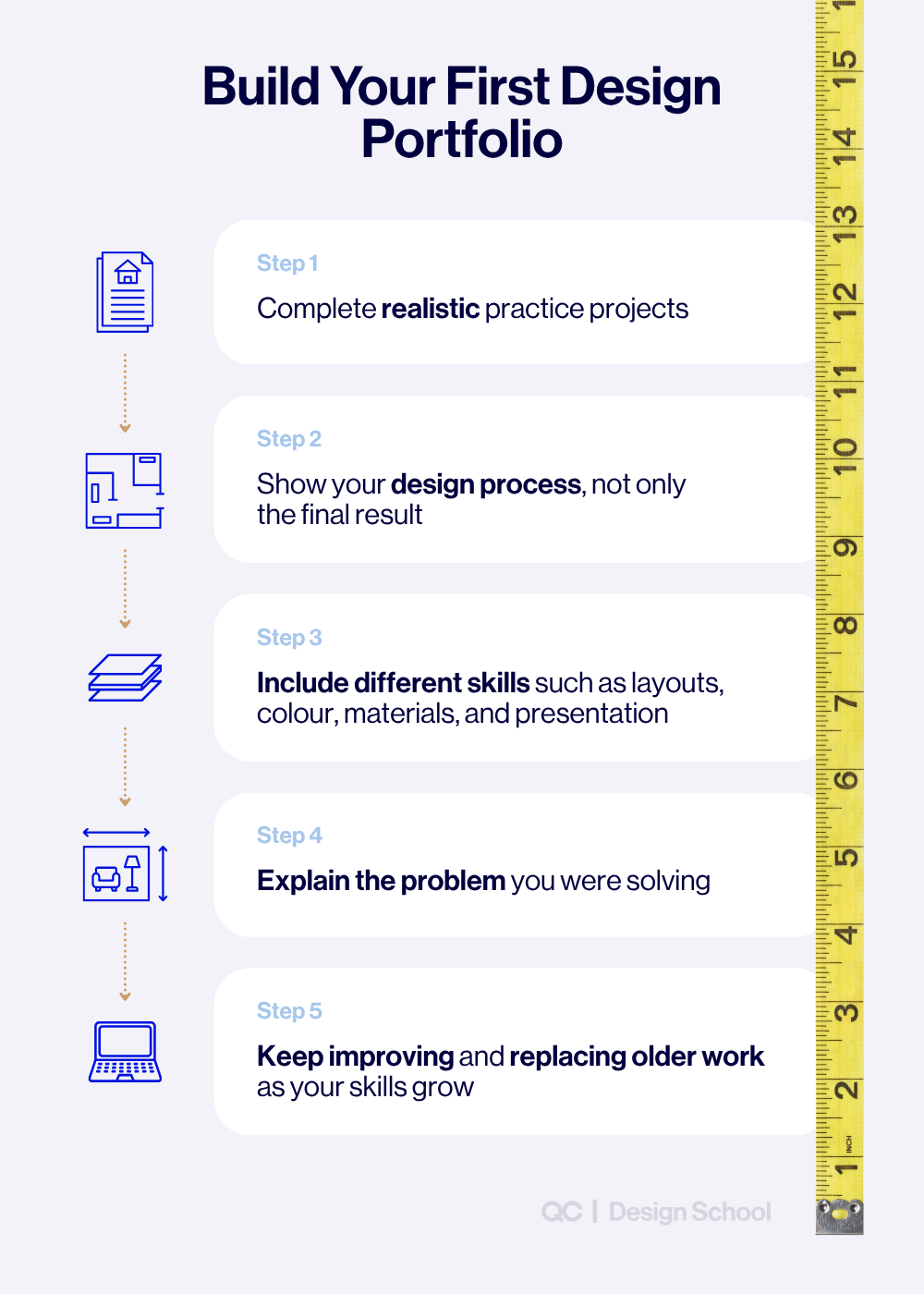
Your first portfolio does not have to be made entirely from paid projects. Coursework, practice spaces, concept projects, and carefully documented personal projects can all help demonstrate how you think and what you can do.
A useful early portfolio should show more than attractive final images. Aim to demonstrate:
- Space planning and layout decisions
- Colour, materials, proportion, and visual cohesion
- Your ability to solve a design problem
- Presentation and communication skills
- The reasoning behind your recommendations
Deborah used her training to strengthen skills she had already begun developing through experience, including design principles, space planning, colour, proportion, and the overall design process. After completing her Interior Design & Decorating course, she continued building a body of work one project at a time.
Each project gave her another opportunity to improve, make professional decisions, develop relationships, and strengthen her confidence.
STAR STUDENTS: Want to see what a strong design portfolio looks like? Explore QC graduate Nicki Panagiotopoulos’s Portfolio.
Getting Past “I’m Not Ready Yet”
How to Build Confidence as a New Interior Designer
Feeling ready is not always what comes first. For many new designers, confidence develops after they begin applying what they have learned.
Deborah is open about experiencing imposter syndrome herself.
“Imposter syndrome is real.”
Her approach was to keep moving anyway: do good work, keep learning, build relationships, and treat each project as another opportunity to improve.
If you are waiting to feel completely confident before doing anything professionally, focus instead on the parts you can control:
- Build a solid foundation of design knowledge
- Practice making and explaining design decisions
- Ask for feedback and use it
- Take on opportunities that match your current skill level
- Keep learning as your experience grows
Formal education can give you a foundation, but experience is what turns that knowledge into professional confidence.
Finding Your Place in the Industry
How to Find Your Interior Design Niche
You do not need to know your niche before you begin your design career.
Early on, it can be more useful to build broad experience and pay attention to the work you enjoy, the problems you are especially good at solving, and the types of clients you connect with.
Over time, Deborah’s work expanded from smaller decorating projects into renovations, restorations, new builds, whole-home design, advisory services, and her own line of furnishings.
As her experience grew, she also developed a clear specialty in wellness design and neurodesign.
For Deborah, wellness design means looking beyond appearance to consider how a space supports the people who use it. That can include light, sound, colour, materials, spatial flow, comfort, and connection to nature. Additional education in healthier materials and sustainable building practices helped her develop deeper expertise in this area.
Her career is a useful reminder that a niche does not need to be chosen on day one. It can emerge from experience, continued education, and the needs you become especially interested in solving.
DESIGN RESOURCE: Not sure how to find your niche and start your Design career? Check out our Interior Design Career Guide.
Learning to Think Like a Professional
How Mentor Feedback Helps New Designers
Learning design principles is only part of becoming a working designer. You also need to make decisions, explain your reasoning, respond to a client’s needs, solve problems, and communicate professionally.
That is where mentor feedback can be especially useful. Feedback gives you an opportunity to see whether your choices work and understand how a more experienced designer approaches the same problem.
Deborah now sees this process from both sides. As a QC Design School tutor, she evaluates student work with an emphasis on professional thinking. Her goal is not simply for students to choose something that looks good. She wants them to understand why they made the decision, whether it works for the client, and whether they can communicate it professionally.
Her industry work also keeps that feedback grounded in current professional practice. Deborah serves as Chair of Education for the Decorators & Designers Association of Canada, volunteers on its Regional Development Committee, and judges the DDA’s annual national design competition.
Growing a Design Business Over Time
How to Build a Design Career That Evolves With You
A successful design business does not need to look the same five or ten years after you start it.
Your services, clients, specialty, pricing, network, and professional interests can all evolve as your experience grows.
Deborah’s career illustrates that progression. Soulier Design Studio expanded as she took on more complex work, developed relationships, continued her education, and became clearer about the kind of design practice she wanted to build.
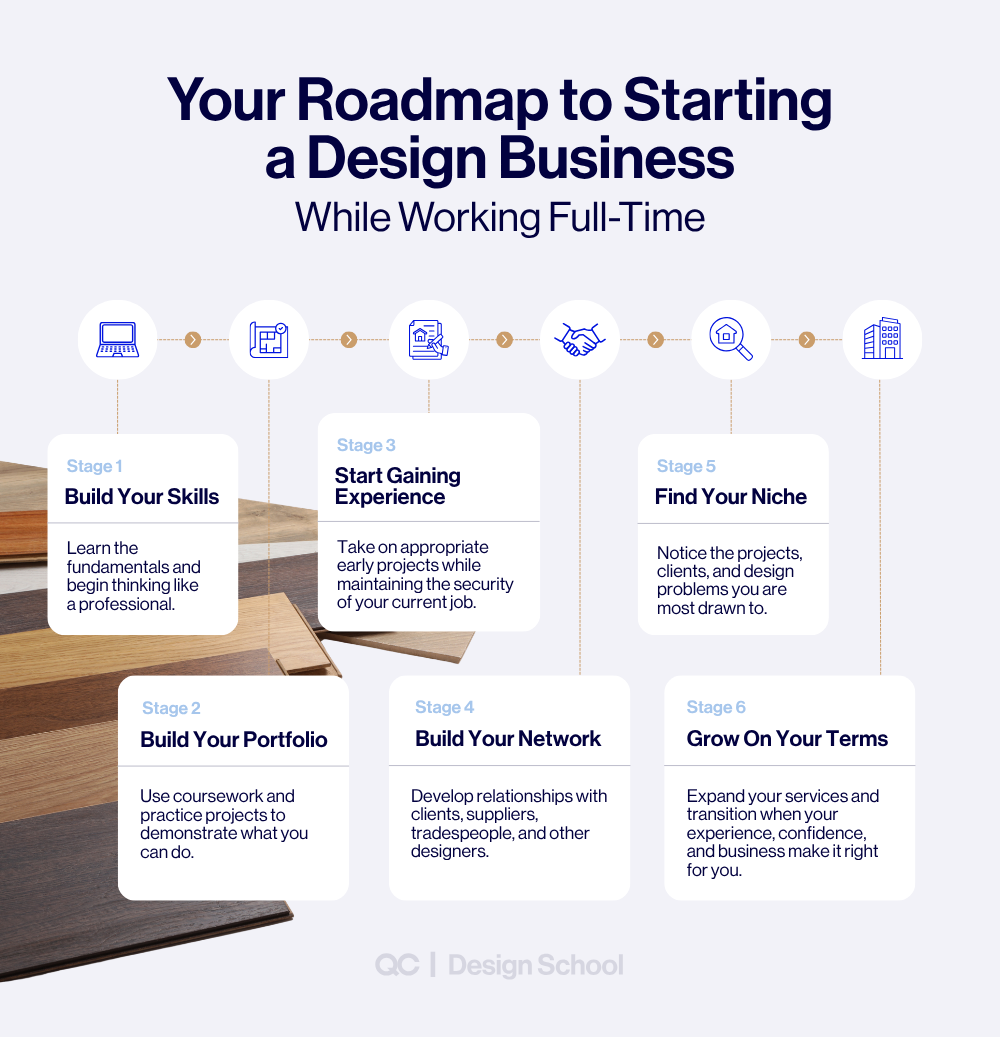
A practical growth path can look like this:
- Build your skills
- Develop a portfolio
- Start gaining experience
- Build your professional network
- Discover which work and clients fit you best
- Develop deeper expertise or a niche
- Expand your services as your business is ready
Deborah’s Advice for Aspiring Designers
Deborah’s career did not begin with perfect confidence or a fully formed business plan. It grew through training, projects, relationships, experience, and continued education.
Her advice to someone considering a design career is simple:
”Just start. Even if you don’t feel completely ready. Confidence comes from experience, and experience only comes from doing the work.
DeborahQC Design School Tutor
You do not have to change everything at once. Start by building your skills and creating work you are proud to show. Then keep taking the next realistic step.
Want to Study Interior Decorating and Design?
If you want to build professional design skills while continuing to work, QC Design School’s flexible online courses allow you to train on your own schedule while building practical skills, a portfolio, and professional confidence.
Frequently Asked Questions About Starting a Design Business
Can I study interior design while working full-time?
Yes. Self-paced online training can allow you to study around a full-time job and other responsibilities. Creating a realistic weekly study routine can make consistent progress more manageable.
What should I put in an interior design portfolio if I do not have clients yet?
You can use strong coursework, concept projects, practice spaces, and relevant personal projects. Focus on demonstrating your design process, decision-making, and the skills you would use on a client project.
How do I know when I am ready to take on my first design client?
You do not need to know everything before taking on a client, but you should be able to confidently handle the scope of the project, communicate your recommendations, understand your responsibilities, and know when a project is beyond your current experience.
Do I need to choose an interior design niche before starting my business?
No. Your niche can develop as you gain experience. Early projects can help you identify the types of spaces, clients, problems, and design approaches you are most interested in.
What should a new interior designer focus on first?
Start with strong design fundamentals, practical experience, a portfolio, professional communication, and relationships within the industry. You can expand your services and specialization as your skills and experience grow.
Start Building Your Design Career
A design career does not have to begin with one enormous leap. You can train around your existing responsibilities, build experience gradually, and create a path that makes sense for your life.
Deborah Soulier did exactly that. What began alongside a full-time career in property management grew into Soulier Design Studio, a long-term design practice shaped by continued learning, specialization, and nearly two decades of experience.